











In the dynamic and ever-evolving world of the real estate industry, the lack of an integrative structure that connects all the dots has become a complex challenge, representing a hidden barrier that hampers efficiency and effective communication.
How is it possible that in a sector so crucial to the global economy, different business areas operate as independent islands, isolated from one another?
From stock generation to after-sales service, each area involved often develops in silos, disconnected from the rest. This misalignment not only creates inefficiencies and increases costs but also negatively impacts the customer experience.
What factors have contributed to this fragmentation, and how can we untangle this web to build a more integrated and efficient real estate ecosystem?
This story explores the roots of this phenomenon and its profound impact on the industry, presenting how a set of interconnected products, acting as a digital backbone, can solve these problems and transform the industry.
The fragmentation in the real estate industry is the outcome of multiple interrelated factors that have evolved over time. These factors have driven the development of silos and a breakdown in communication between different business areas within the new real estate asset sales process.
Historical Evolution of the Industry
As the real estate industry expanded, companies grew organically, developing departments, products, and business areas in isolation.
This uncoordinated growth led to the creation of organizational silos, hindering communication and coordination.
Lack of Standardization
The absence of technological standards and common nomenclature within the industry hinders interoperability between different systems and platforms.
The lack of standardization negatively impacts the customer experience, causing delays and errors.
Resistance to Change
Resistance to change and organizational inertia prevent the adoption of integrated and collaborative approaches.
Organizations have deeply ingrained processes that are difficult to alter, perpetuating fragmentation.
Markets Factors
The inherently complex and multifaceted nature of the real estate market contributes to fragmentation.
Managing multiple activities led to specialization and the creation of isolated departments.
Technological Factors
Technological innovations in specific areas, such as digital marketing and sales or asset management, were implemented without considering the need for integration with other systems.
The rapid adoption of new technologies resulted in solutions that do not align with a global technological infrastructure.
Organizational Factors
Traditional organizational structures foster a siloed culture, where each department operates independently and competitively.
The lack of incentives for collaboration and internal competition reinforces fragmentation.

The specific effects of each factor are profound, impacting operational efficiency, decision-making, customer experience, and market competitiveness.
Reduced Operational Efficiency
Uncoordinated expansion and disparate technologies lead to redundant processes and elevated operational costs.
Poor Data Visibility and Management
The lack of standardization hinders data integration and informed decision-making.
Poor Customer Experience
Inconsistent processes and a lack of technological standardization negatively impact customer satisfaction.
Limited Innovation and Adaptability
Traditional structures and resistance to change stifle innovation and adaptability in the market.
The core business areas essential for covering each stage of the sales flow for new real estate assets are clearly defined, ensuring the successful conversion of an asset into a sale.


This scenario creates a significant imbalance in how the workload is distributed among business areas. These operational inefficiencies adversely affect the industry’s ability to respond with agility and efficiency to market demands.

Asset Management
and Distribution

Sales Force and
Marketing

Transaction Formalization
and Closing

Customer Support
and Post-Sale Services
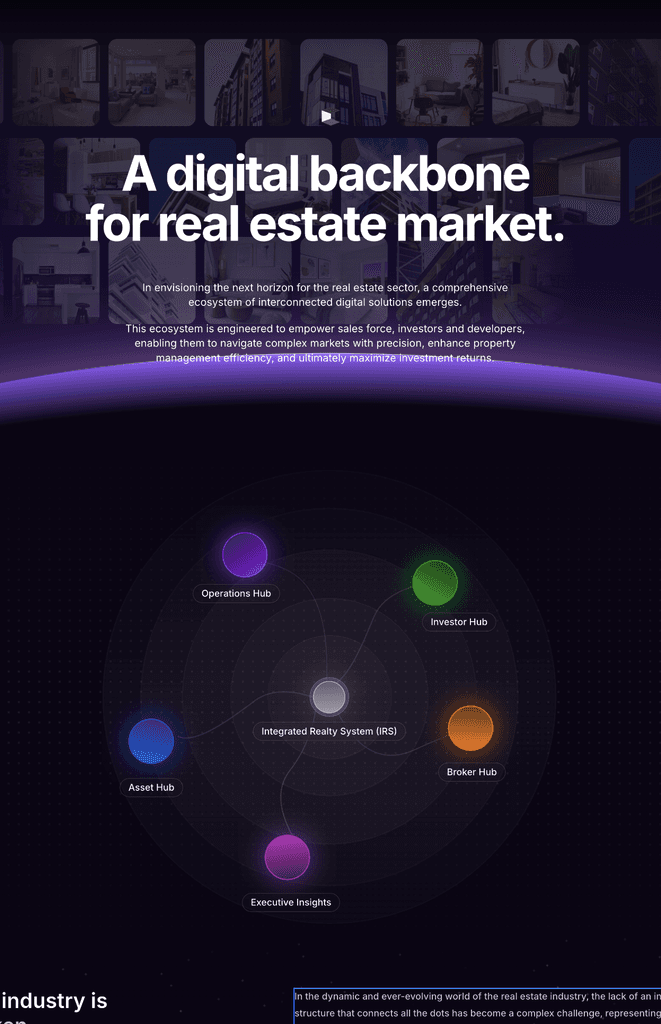
An integrated digital ecosystem that interconnects powerful solutions to empower sales teams, investors, legal and operational teams, and developers, helping them to manage the complexities of the market with precision, optimize property management efficiency, and maximize their return on investment.

This system effectively redistributes workload, improving operational efficiency by optimizing each area, allowing them to synergize and amplify each other’s impact.
Asset Management
and Distribution
Sales Force and
Marketing
Transaction Formalization
and Closing
Customer Support
and Post-Sale Services
At the core of this system lies a new model called the Integrated Realty System (IRS), whose mission is the strategic implementation and management of these five fundamental digital solutions. These tools are intrinsically connected, with each enhancing the capabilities of the others as they collectively advance the broader mission of refining real estate operations.
The IRS functions as a ‘central intelligence node’ within the real estate ecosystem, much like how a blockchain system operates in the financial world, where security, data integrity, and decentralization are paramount. This system not only facilitates the seamless integration and efficient flow of information among all involved parties but also ensures high levels of transparency and traceability, allowing for real-time verification of every transaction and operation. By centralizing and distributing critical data, the IRS optimizes operations, minimizes human errors, and significantly enhances operational efficiency, ensuring that all decisions are made based on a solid foundation of reliable information.
Unified Ecosystem Approach
Central to the strategy is a unified digital platform where each solution amplifies the others, creating a sum greater than its parts.
Scalability and Flexibility
Designed to grow seamlessly with the business, these solutions adapt fluidly to ever-changing market conditions and client needs.
Market Leadership
By combining innovative solutions with strategic marketing, the aim is to achieve a dominant position in the real estate technology space.
User-Centric Design
Each tool is crafted to be intuitive, meeting the specific needs of real estate professionals through user-friendly interfaces and functionality.
Data-Driven Decision Making
Advanced analytics and AI drive smarter, more informed decisions across the platform.
Integration and Interoperability
Ensuring compatibility with existing systems, the solutions enhance rather than disrupt current workflows.
Continuous Iteration
A commitment to ongoing refinement based on user feedback and emerging tech trends keeps the solutions at the cutting edge.

Héctor Campillay Borda
Elevate Your Business OR IDEA to New Heights with World-Class Product Design.
Suited for businesses seeking strategic design and innovative ideas, paired with the expertise of a senior designer offering exceptional quality at emerging market costs.